
Every backtest looks good
That is close to literally true. A search that tries thousands of rule sets on the same price history and keeps the best one will always find something with a rising equity curve, because among thousands of variations some fit the past by chance. The more you try, the better the winner looks, and the less the winner means.
The founder of BotFactoryFX has used StrategyQuant X every day for years. He has built strategies that pass Monte Carlo and a dozen other robustness tests, and he still had no robot that paid. Strategy generators are very good at generating. What you need before risking money is a verdict: is this result real, or is it the luckiest of a thousand coin flips? So we built the judge first, and the programs around it.
One engine, three jobs
The three programs share the same measuring engine, so a number means the same thing in each of them. All three run on your own computer, with no account and no cloud.
| Program | When | What it does | Price |
|---|---|---|---|
| BFInspector | Before you buy a robot | Reads its code and the backtest you were shown, finds the known traps and replays its trades with your money. For manual traders: position sizing, losing streaks and a trading journal. | Free |
| BFQuarantine | After you bought one | Sets the trades it really closed, in the account where it runs, against the backtest it was sold with. It never runs the robot and never places an order. | 199 USD, once |
| BotFactoryFX | To build and judge your own | Genetic search, the Reality Check, quarantine on live candles, portfolios, live monitoring of your robots, an AI assistant and native code for six platforms. | 999 USD, once |
BotFactoryFX: build thousands, keep the ones that hold
BotFactoryFX is an algorithmic trading lab. It builds strategies by the thousand and then spends most of its effort trying to prove that each one is worthless. What survives is written out as code you can run on your platform. The menu follows the order of the work: data, build, judge, library, quarantine, portfolio, live.
Data first. Price history comes from your broker's CSV, Dukascopy (1,615 instruments), Binance (more than 500 pairs), MetaTrader 5, JForex or a web3 wallet. Every series is audited before it is used, because bad data produces very convincing strategies. Two of the things we found that way: Dukascopy's free feed makes up candles for the closed weekend, and one broker's EURUSD H1 history carried the day's high or low inside its midnight candle, which a search exploits at once.
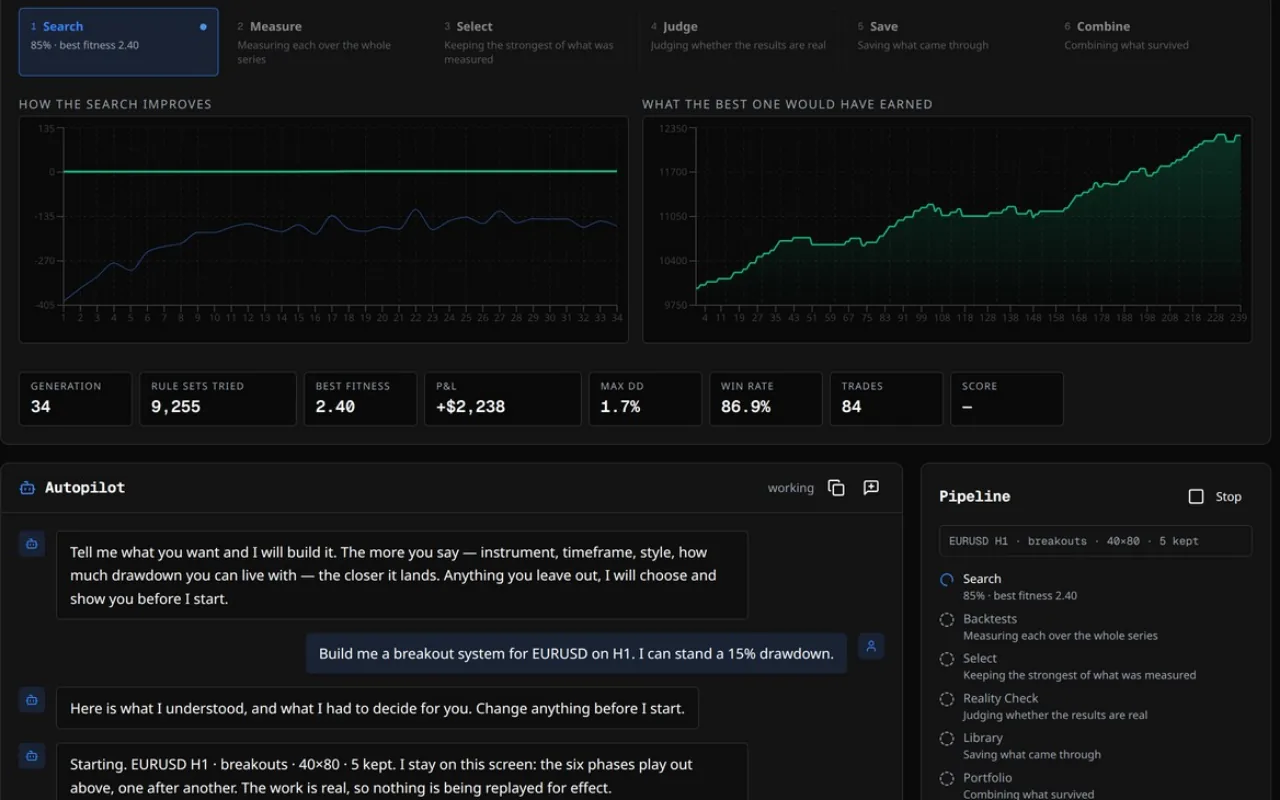
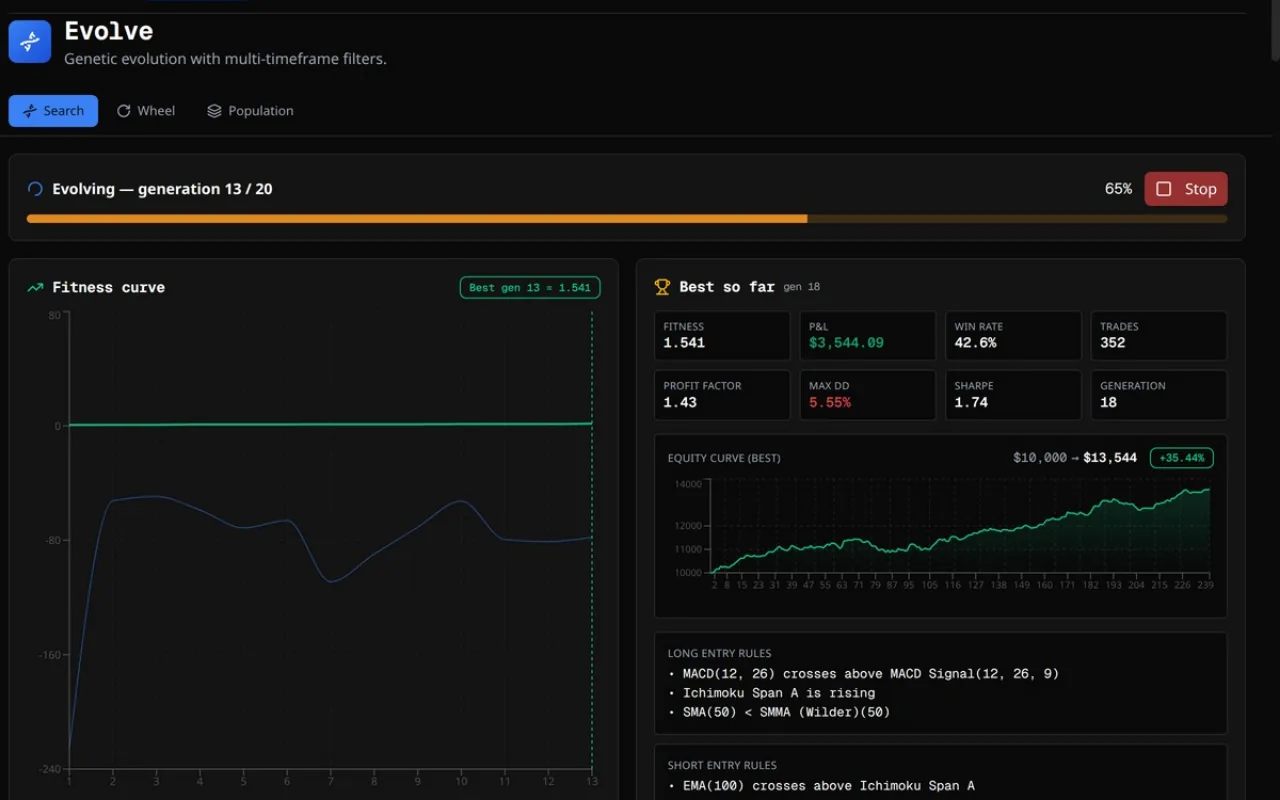
Search. The genetic search, Evolve, tries thousands of rule sets per run across seven families: trend, breakout, mean reversion, price action, momentum, volatility and divergence, and mixes them when that pays. You can also write rules by hand, or describe an idea in plain words and let the assistant write it with the program's own indicators. The autopilot can test the procedure itself, repeating the whole search on five windows of the history and trading what each one found on the stretch that came next.
The Reality Check
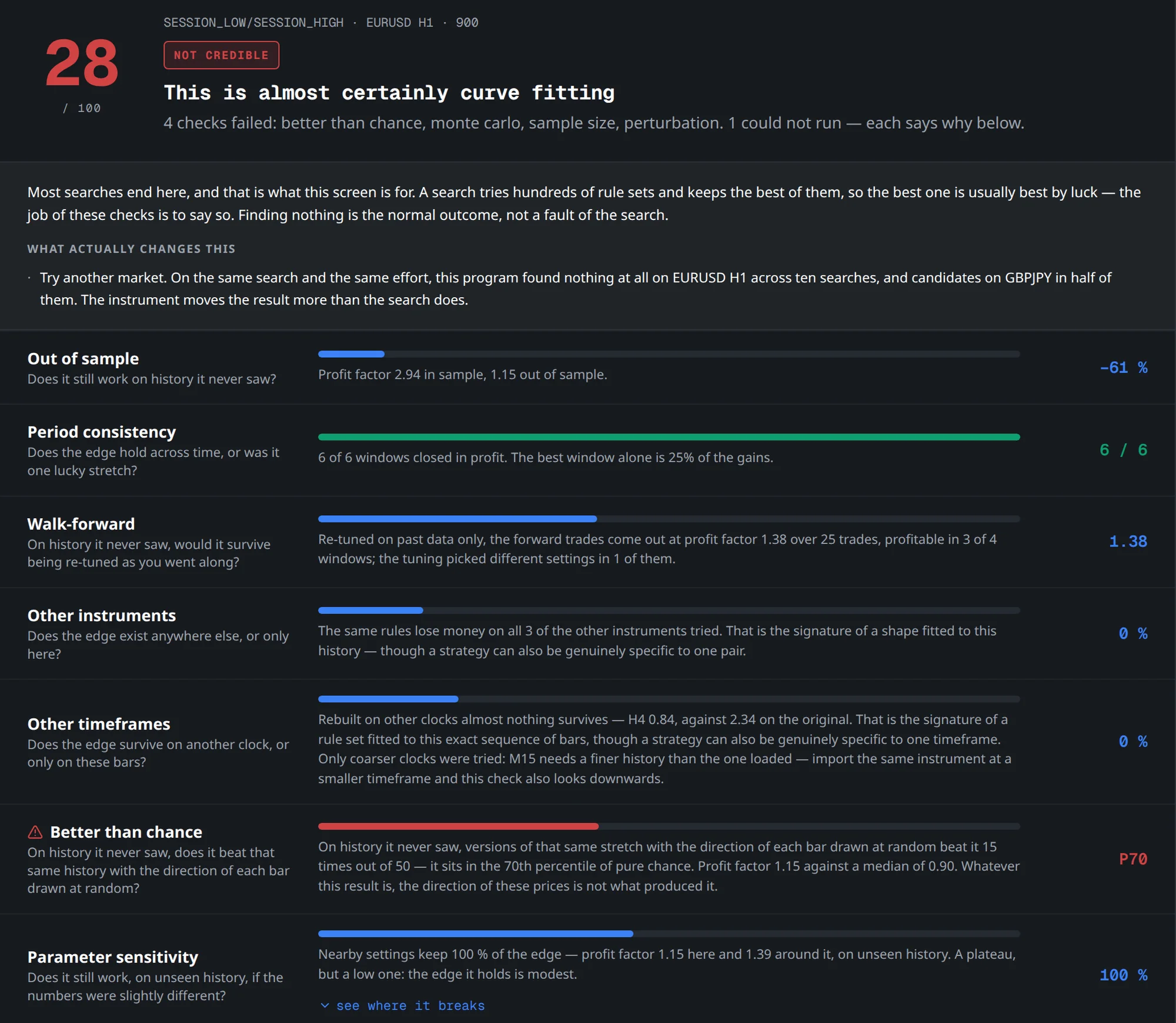
This is the center of the program. The judge does not ask whether a strategy made money. It asks whether the result is real. It runs thirteen checks, nine of them on the last stretch of history, the one the search never saw: out of sample, better than chance, walk-forward, parameter sensitivity, Monte Carlo, other instruments, other timeframes, sample size, period consistency, perturbation, bar resolution, cost tolerance and drawdown.
Two things make it more than a checklist. It knows how hard the search looked: the best of 9,000 rule sets has to show more evidence than a strategy you wrote by hand, so the judge raises its bar with the size of the tournament, and from the search's own records it computes the deflated Sharpe ratio (Bailey and López de Prado, 2014) and the probability of backtest overfitting (Bailey, Borwein, López de Prado and Zhu, 2014). Even the name has a pedigree: Halbert White called his test for data snooping “a reality check” in 2000. And it was calibrated on noise: we fed it thousands of strategies fitted to random price paths, which have no edge by construction, and counted how many it approved.
That is why its four verdict words, Solid, Fragile, Weak and Not credible, mean something: we measured how often noise earns each one.
A real case, filmed for our Spanish home page. One sentence to the autopilot; 9,963 rule sets tried; five strategies kept, the best of them winning 77% of its trades in the backtest. Its profit factor was 1.68 on the history it was built on and 1.00 on the history it never saw. The judge passed none of the five. That is its job: the money you do not lose in a live account.
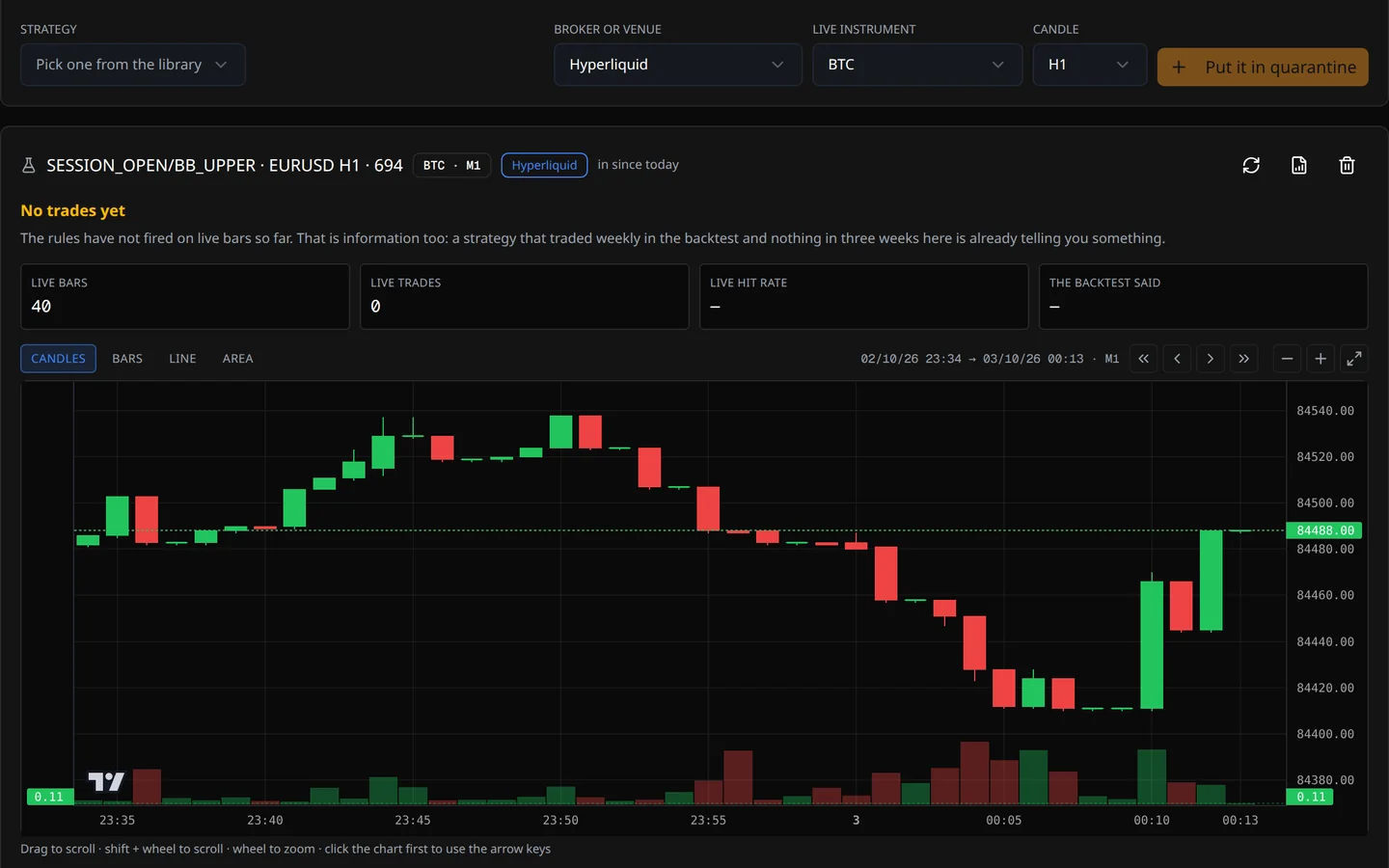
Quarantine, live and export. A strategy that survives the judge still has to survive time. The Quarantine runs it on the candles that arrive from your account, through MetaTrader 5 or JForex, or without an account from Hyperliquid, Binance or Dukascopy, with simulated orders, and compares what happens with what the backtest promised. Nothing has to stay switched on: it catches up when you open it, and it never sends an order. When a strategy has earned it, BotFactoryFX writes it in native code for MQL4, MQL5, Java for JForex, C# for cTrader, Pine Script and Python for Hyperliquid, compiled with each platform's own compiler and with an account kill switch, trading hours and a Friday close inside. Live then reads your robots in MetaTrader 5 and JForex and shows how far each one drifts from its backtest.
Dr. Quant is the assistant inside. It runs on your own AI key, with OpenAI or any compatible service, Anthropic, Google Gemini or OpenRouter, or on a model on your own machine, and every answer shows what it cost. It knows how the judge works and what the Help says, and it explains any concept you ask about. It does not trade and it does not touch your library.
BFQuarantine: is it still the robot you bought?
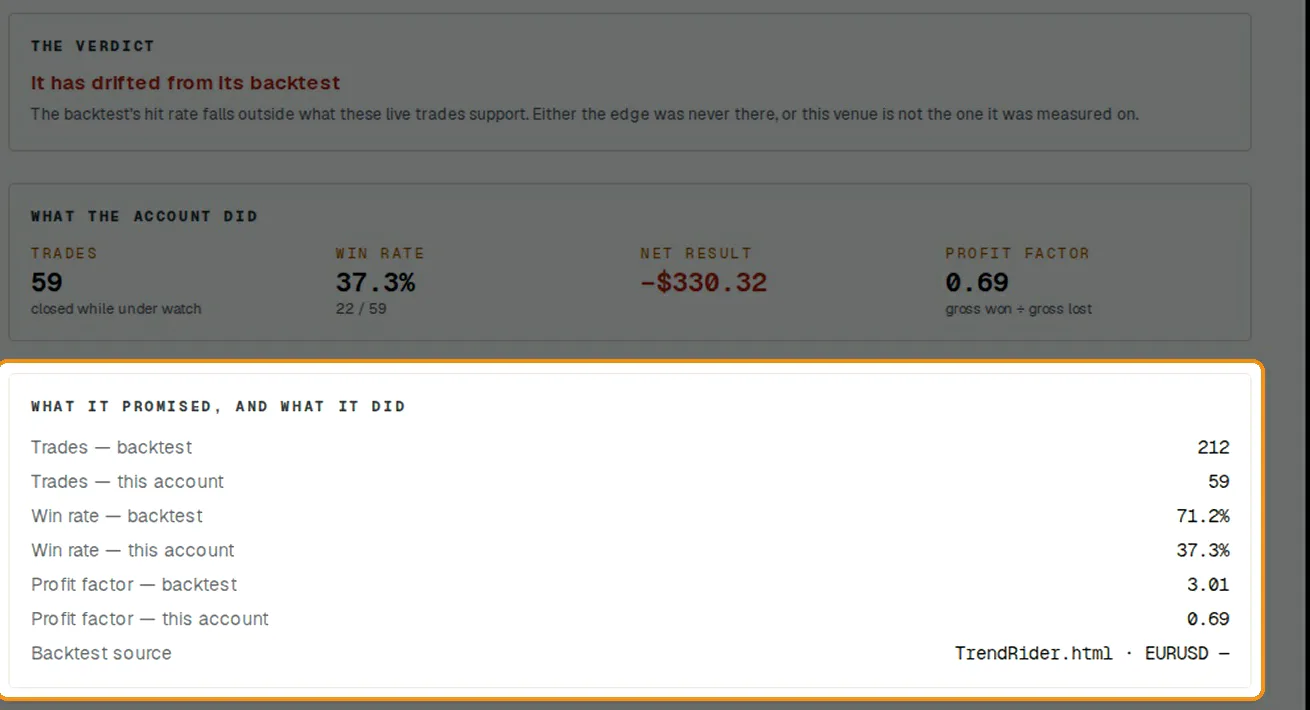
You bought a robot, and its backtest said 71% winning trades. BFQuarantine reads the trades it really closed in the account where it runs, on MetaTrader 5, MetaTrader 4, JForex or a web3 wallet, draws them on the candles they were made on and sets them against the backtest it was sold with. It never runs the robot's code and never places an order: its bridge to the platform only reads.
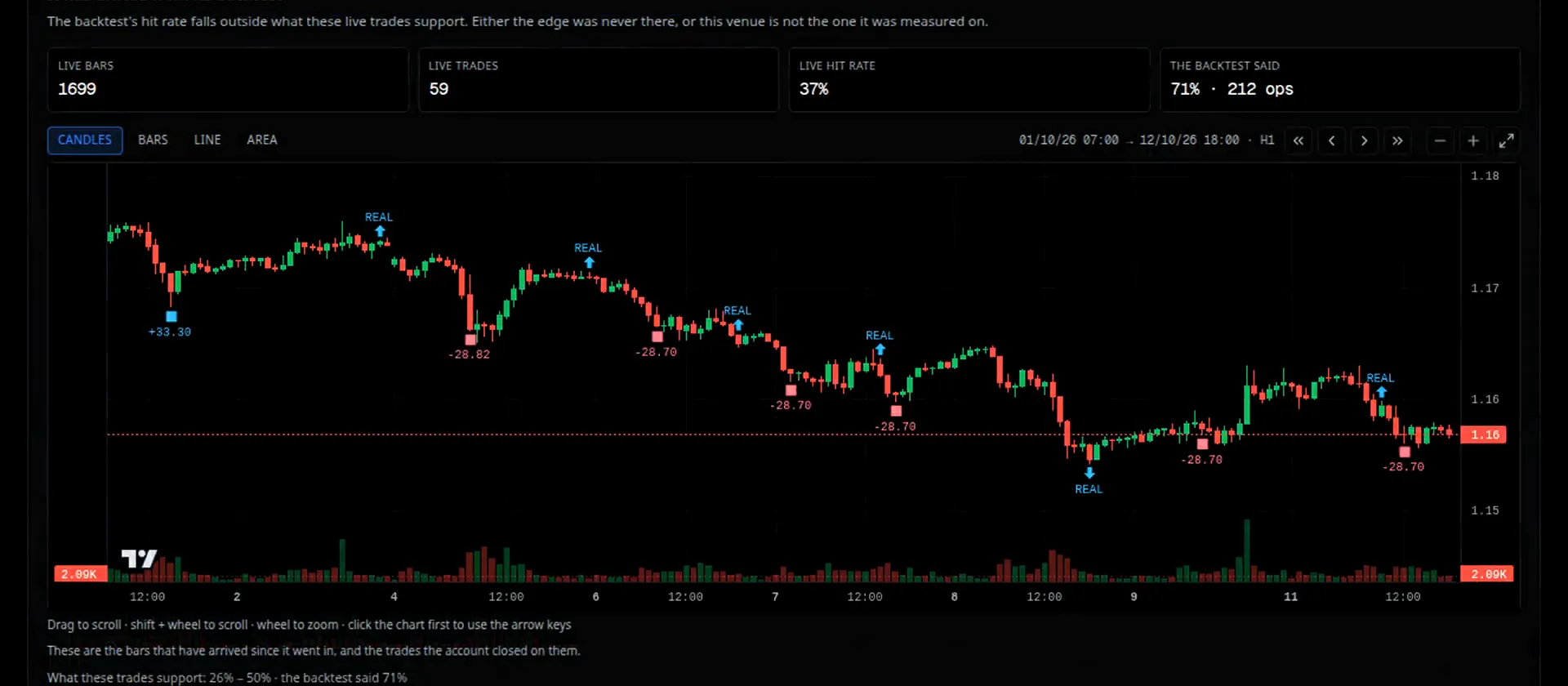
If the live results fall outside what the backtest can support, the verdict says so: either the edge was never there, or this venue is not the one it was measured on. If they are still inside, it says that too, and adds that this is not proof it works, only the absence of evidence that it broke. The report is made to keep.
BFInspector: before you pay
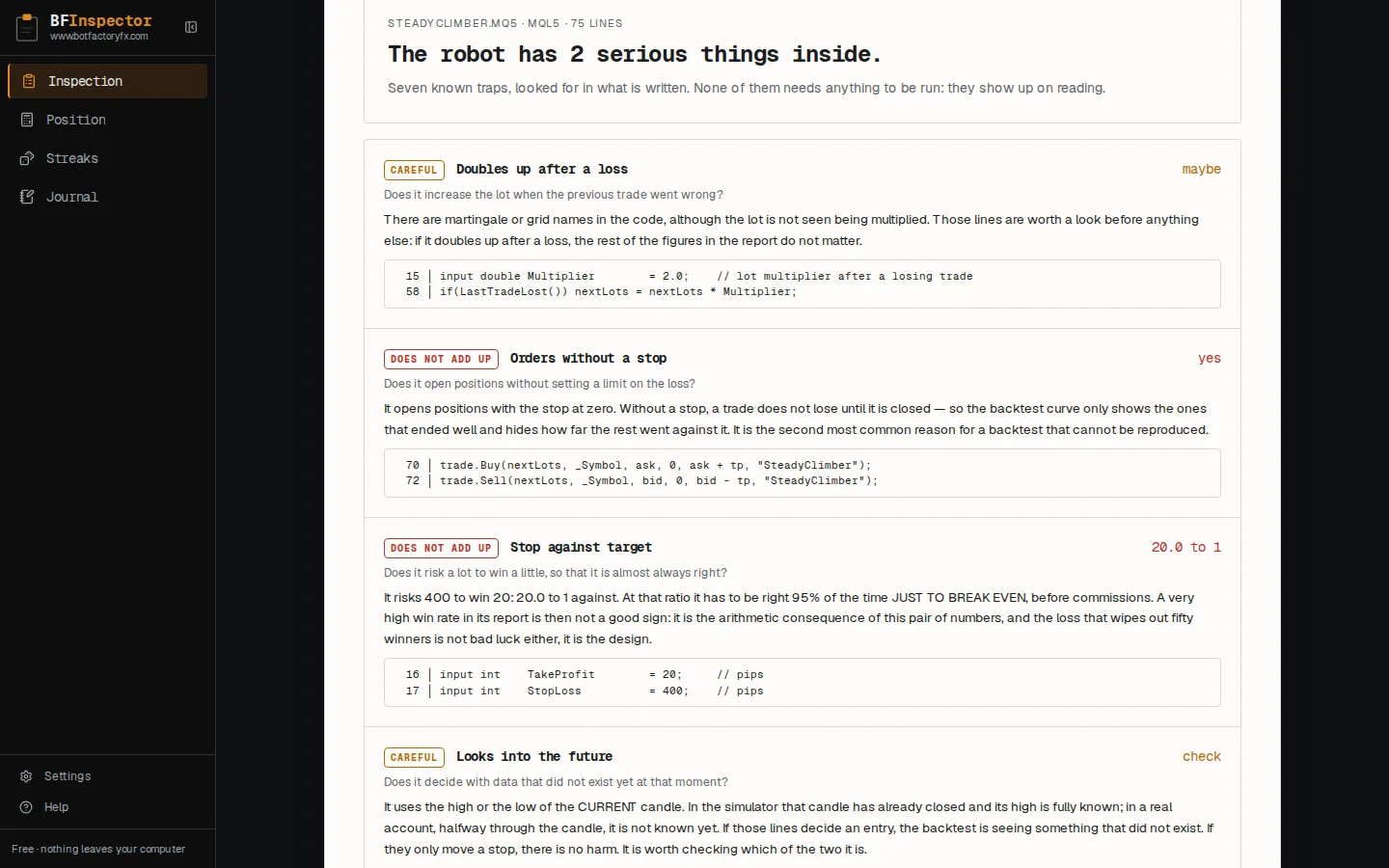
Someone wants to sell you a robot whose backtest shows 93.7% winning trades and +32% in a year. BFInspector reads three files: its code, the backtest you were shown and your own price history. It writes down in plain words what the robot does, looks for seven known traps in the code, from doubling up after a loss to orders without a stop or rules that read the current candle before it has closed, and runs six checks on the report, such as prices that never existed or entries too good to be chance.
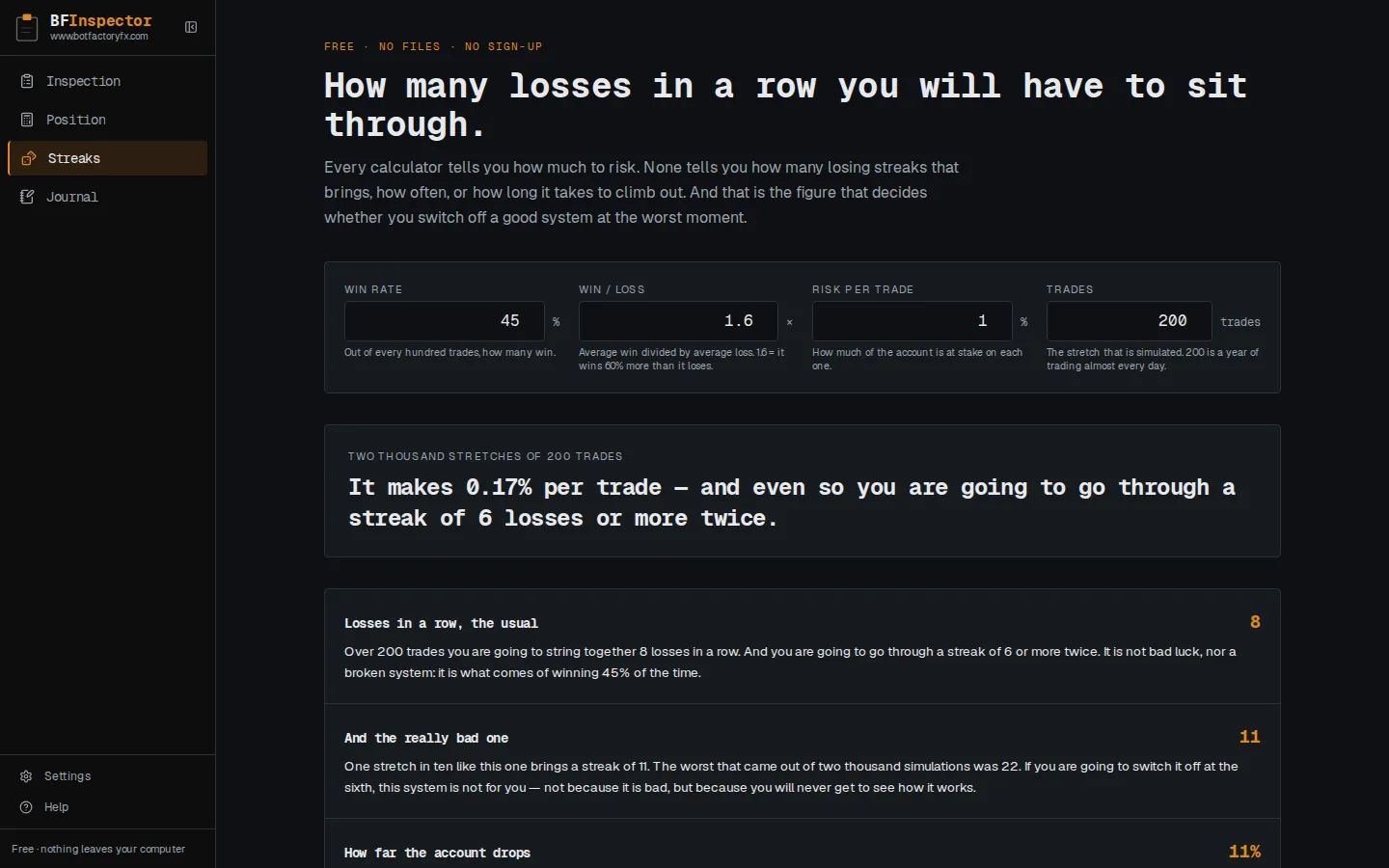
Then it replays the robot's own trades with your capital, your lot size and your costs, and again at the costs of other kinds of broker account. For manual traders it adds a position calculator that always rounds the lot down, a losing-streak simulator that tells you how many losses in a row your plan will make you sit through, and a journal that gives your own trades the same report a robot gets. It is free, needs no sign-up and nothing leaves your computer.
How it was built
Development started in August 2026 with one priority: the judge before everything else. A few rules have held since. Every number on screen comes from the program. A message to the user is a claim about a cause, so it has to be true. When a measurement kills one of our own ideas, we say so and change course. Some milestones, mistakes included:
| When | What |
|---|---|
| August 2026 | A desktop program that runs locally, with the Reality Check as its spine instead of a cheaper toolbox. |
| 7 September | The judge recalibrated on noise: from approving 94% of noise-fitted strategies to 6%. |
| 17 September | We started compiling every export with each platform's own compiler and found that the JForex export had never compiled. Every version is checked that way since. |
| 18–20 September | Three adversarial reviews of the judge and the engine. Among other things, a rule reading a slower timeframe could see that bar before it had closed. Fixed. |
| 29 September | The deflated Sharpe ratio and the probability of backtest overfitting join the judge, and the data audit learns to spot a candle that carries the future. |
| October | The procedure test; BFQuarantine and BFInspector as separate programs; BFInspector's calculator and journal; every program in English and Spanish. |
Behind it there are some 1,270 commits and more than 8,000 automated tests, run in full before any change is kept.
The tool has to work in our hands first
Before selling it we set ourselves a rule: no launch until BotFactoryFX found, in our own hands, a strategy its judge rates Solid. This is what our searches looked like, with the autopilot's procedure and the strictest standard, Solid on the instrument and Solid again with its closest sibling market as the subject:
| Market and its sibling | Searches | Searches that found one passing both |
|---|---|---|
| S&P 500 with the Dow, daily | 30 | 3 |
| Bitcoin with Ethereum, daily and H4 | 600 | 0 |
| EURUSD with GBPUSD, daily and H4 | 100 | 0 |
| GBPUSD with EURUSD, daily and H4 | 100 | 0 |
| Gold with silver, daily and H4 | 100 | 0 |
| Apple with Microsoft, daily and H4 | 100 | 0 |
| Russell 2000 ETF with SPY, daily and H4 | 100 | 0 |
That table is the product working. A tool that finds an edge in every market would be finding noise. One of the S&P 500 strategies is now running in quarantine, where time will judge it again.
A verdict, not a bigger toolbox
The best-known tool in this space is StrategyQuant X, and it is excellent. On its website it was listed at 1,290 USD (Starter) and 1,490 USD (Professional, the edition with its robustness tests), both with one year of updates and 300 USD a year after that, and 2,900 USD for Ultimate with lifetime updates. It offers more building blocks and more export targets than BotFactoryFX, and some traders will need exactly that. BotFactoryFX makes a different bet: instead of the largest toolbox, the clearest answer to one question. 999 USD once, lifetime updates, no subscription, up to three of your machines; all thirteen checks included; one sentence to the autopilot; quarantine without risking money; and you can run the program in your browser before paying.
What it does not do
- It does not promise a profitable robot. No program can. What it can do is tell you early which ones are not, and watch the rest without risking money.
- The engine holds one position at a time, so grids and stacked entries are out of scope.
- It has fewer indicators and export targets than the largest tools: no NinjaTrader or TradeStation.
- The Windows and macOS builds are not code-signed yet, so your system asks for confirmation the first time.
- For now it is paid in crypto, USDT or BTC.
The quickest way to judge all this is to try it: start with BFInspector, which is free, or run BotFactoryFX in your browser before paying.
Where the numbers come from
From the programs and our own measurements: the judge's recalibration on noise of 7 September 2026; the autopilot run on our home page; and the searches of 13 to 16 October 2026, run with the autopilot's procedure in our own harness. StrategyQuant X prices as listed on its website on 2 October 2026. The screenshots of BFQuarantine and BFInspector use example files made up for them.